Suunto Nautic User Guide
Decompression dives
When you exceed the no-decompression limit, Suunto Nautic provides the decompression information required for ascending depending on the decompression profile.
Once the No deco time is at 0 min, the display area will change to show the Deco time (also referred to Time to surface): optimum ascent time in minutes to surface with given gases.
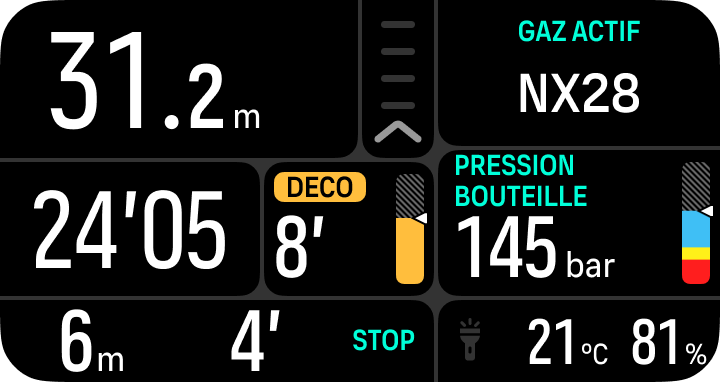
The ceiling value will be displayed in the stop area either alone or together with the recommended stop depth, depending on your set decompression profile. The ceiling value indicates the first decompression stop depth.
You can set the last stop depth to 3.0 m or 6.0 m (the default depth is 3.0 m) in the Algorithm settings. See Last deco stop depth.
On a decompression dive, different stop types can be present:
- Decompression stop: A compulsory stop if diving with a Stepped decompression profile (see Deco profile). Decompression stops occur at fixed 3 m (10 ft) intervals.
- Safety stop: If safety stop time has been set, you will have an extra safety stop after the last decompression stop. Safety stop is always non mandatory for decompression dives.
There is a decompression window at 3 m (9.8 ft) between the decompression floor and decompression ceiling. The closer to the ceiling you stay, the more optimal the decompression time is.
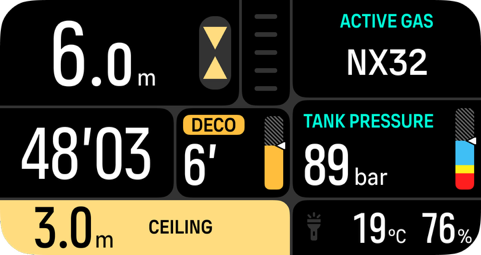
When you ascend close to the ceiling depth and enter the decompression window area, two arrows appear next to the depth number.
If diving with a Stepped deco profile, a timer will start the countdown when entering the decompression window and the ceiling is the same for a specific time and then moves upwards 3 m (9.8 ft) at a time.
Inside the decompression window (Stepped profile):

In the Continuous ascent mode, the ceiling is constantly decreasing while you are near the ceiling depth, providing continuous decompression with optimum ascent time.
Inside the decompression window (Continuous profile):
If you ascend above the ceiling depth, there is still a safe margin area, equalling to the ceiling depth minus 0.6 meters (2 ft). In this safe margin area, decompression calculation still continues, but you are advised to go down below the ceiling depth. This is indicated with a downward pointing yellow arrow next to the depth value.
The following is displayed using the Stepped decompression profile:
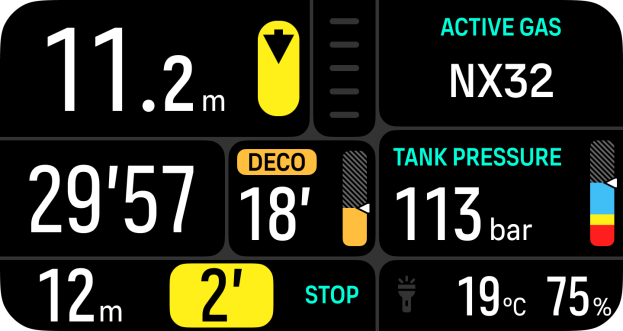
The following is displayed using the Continuous decompression profile:

If you go above the safe margin area, the decompression calculation is paused until you go back down below this limit. An audible alarm and a downward pointing red arrow in front of the ceiling depth value indicate unsafe decompression. If you ignore the alarm and stay above the safe margin for three minutes, the stop is considered missed and an algorithm violation notification will appear.
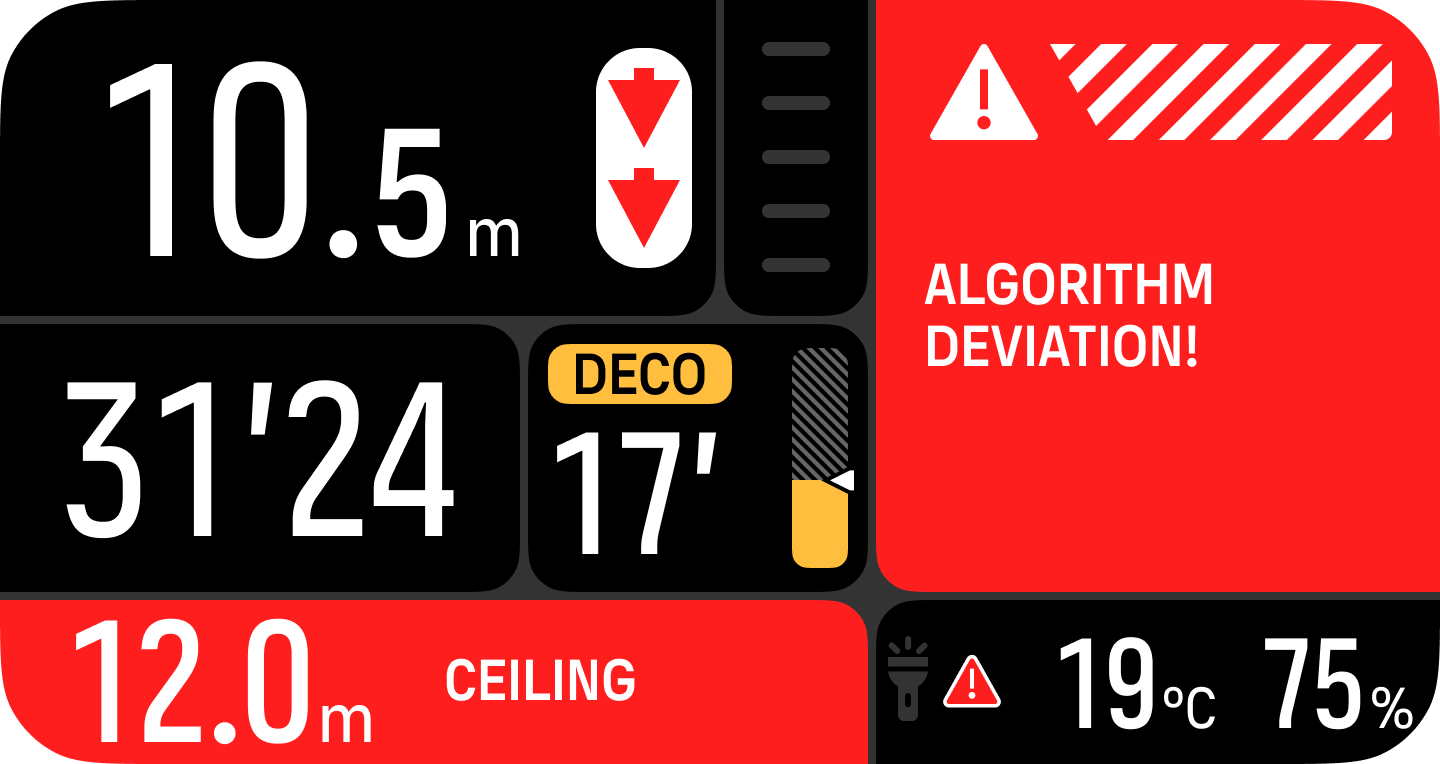
Suunto Nautic does not lock after you confirm the algorithm deviation trigger alert. Suunto Nautic continues showing the original decompression plan even if the decompression stop is violated. A red warning will appear in the window and it will stay in the diving window until the required decompression stops are cleared or after 48 hours.
Algorithm violation can also occur in the following situations:
End of battery
Software crash
Exceeding the maximum depth limit of device (200 m).
In all of the cases, the algorithm deviation icon will appear in the dive window, but the algorithm will function as normal. If an algorithm deviation has occurred during the dive, you will also see a header in the dive log and in Suunto app.
Only perform decompression diving if you have received proper training to do so.
NEVER ASCEND ABOVE THE CEILING! You must not ascend above the ceiling during your decompression. In order to avoid doing so by accident, you should stay somewhat below the ceiling.
YOUR ACTUAL ASCENT TIME MAY BE LONGER THAN DISPLAYED BY THE DIVE COMPUTER! The ascent time will increase if you: (1) remain at depth, (2) ascend slower than 10 m/min (33 ft/min), (3) make your decompression stop deeper than at the ceiling, and/or (4) forget to change the used gas mixture. These factors might also increase the amount of breathing gas required to reach the surface.
Diving with multiple gases and dismissing a gas switch prompt will provide you with inaccurate Time to surface values and longer decompression stops than predicted.