Your running watch shows a cadence number on every run, but what does it actually tell you? Should you aim for 180 steps per minute (SPM), and is a higher cadence worth working toward? The number on its own says little. What matters is how it relates to your pace, your running conditions, and your natural rhythm.
Before changing anything, check whether your current cadence suits the running you do. If an adjustment makes sense, start small, practice in short intervals, and judge the results by how your training and your body respond.
What Is Running Cadence, and How Is It Related to Pace?
Running cadence, also called step rate, is the number of steps you take per minute, counting both feet. It's measured in steps per minute (SPM), so a reading of 170 SPM means you're taking roughly 170 steps every minute.
How Is Cadence Related to Pace?
Your running speed comes down to two things: cadence and step length, the distance you cover with each step.
Speed (feet per minute) = Cadence (steps per minute) × Step length (feet per step)
Pace is the time it takes to cover a set distance, usually shown in minutes per mile. The faster you run, the lower your pace.
To run faster, you can take more steps per minute, cover more ground with each step, or do a bit of both. That's why a higher cadence alone doesn't guarantee a faster run. Step length decides the rest.
What Is the Ideal Running Cadence?
No single cadence suits every runner. Cadence shifts with pace and running conditions, and individual traits such as height may play a part, but none of these factors sets your target on its own. A better question than "What's the ideal number?" is "Does my cadence work for me at this pace, in these conditions?"
So why does 180 SPM come up so often? The number has a specific origin, and it was never meant as a universal goal.
Where Does 180 SPM Come From?
The widely cited figure of 180 steps per minute comes from Jack Daniels’ observations of elite middle- and long-distance runners at the 1984 Los Angeles Olympics. Nearly all the athletes he observed ran at 180 SPM or higher.
Two points are important when interpreting that number:
- These were observations of elite athletes during competition, not findings from a controlled study.
- Cadence measured during a race shouldn’t be treated as a target for recreational runners on easy runs.
Those observations alone don’t establish that every runner should reach 180 SPM. Even among elite runners, cadence varies considerably: a study tracking 20 elite ultramarathon runners during a 100-kilometer road race found that individual runners’ average cadences ranged from 155.4 to 203.1 SPM.

How to Increase Running Cadence
If you decide to work on your cadence, aim for a rhythm that suits you rather than a fixed SPM figure. Make small adjustments, test them in short practice intervals, and let your body's response and your training guide what comes next.
When Should You Increase Your Running Cadence?
Not every runner needs to. If your current cadence carries you through your runs comfortably and consistently, and your form feels sound, leave it as it is. A number that looks high or low is not a reason to change it.
A cadence adjustment is worth trying when there's a specific goal behind it, such as feeling more in control of your stride at certain paces, holding a steadier rhythm, or working on a particular part of your technique.
Start by naming what you want to improve. Then build a baseline by tracking several comparable runs and recording your cadence, pace, route, perceived effort, and any physical symptoms. That record gives you a reference point to measure changes against.
How to Increase Your Running Cadence Gradually
Start with your baseline cadence from runs at a similar pace and under similar conditions, and try a small increase. For example, you could start with an increase of about 5%, practicing for short intervals during easy runs or running drills while monitoring how your body responds.
Here’s one example of a short practice session—not a standard plan for every runner:
- Warm up with 10–15 minutes of easy running.
- Add 4–6 cadence drills lasting 30–60 seconds each at a slightly higher cadence than your baseline.
- Recover between drills with 1–2 minutes of easy running at your natural cadence.

If helpful, use a metronome, the beat of a song, or prompts from your running watch to stay on rhythm. Once the short intervals feel relaxed and natural, gradually extend the practice time.
Focus on light, relaxed steps and a steady rhythm, allowing your step length to adjust naturally. Don’t deliberately lift your knees higher, push off harder, or take stiff, shuffling steps just to hit a target number.
Keep your effort level as consistent as possible. If increasing your cadence makes you run noticeably faster, ease back on the pace so your body can first get used to the new rhythm.
How to Evaluate the Change
A higher SPM reading alone doesn't tell you the change is working. The real test is whether you can hold the new rhythm naturally across comparable runs, and whether it serves the goal you started with.
Ask yourself:
- Do you feel more relaxed, and is a steady rhythm easier to hold?
- Has the issue you set out to address improved?
- Can you still complete your runs at a similar pace and in similar conditions?
- Have you noticed any new or worsening discomfort, pain, or unusual fatigue?
If the new rhythm is hard to sustain or leaves you noticeably more tired, scale back the adjustment or shorten the intervals. There's no rush to increase it further.
If new or worsening pain appears, stop the cadence work for that session. Persistent pain or rehabilitation needs should be assessed by a healthcare professional or sports physical therapist.

Why Does Running Cadence Change?
Cadence isn't a fixed number. Pace, terrain, fatigue, workout type, and other conditions all move it, so differences between runs, or between parts of the same run, are normal and rarely point to a problem with your form.
How Does Running Cadence Change With Pace?
Cadence generally increases as you run faster, but the amount varies from runner to runner. There’s no fixed relationship that applies to everyone.
A treadmill study of 30 experienced adult runners found that as runners sped up from a 10:00-per-mile pace (about 6:13 per kilometer) to a 7:00-per-mile pace (about 4:21 per kilometer), average cadence rose from approximately 169 to 178 SPM. However, some runners showed very little change in cadence, suggesting that running faster doesn’t always require a large increase in step rate.
Treat these figures as an illustration of how cadence can shift with pace, not as targets to hit at each pace.
How Do Terrain and Running Conditions Affect Cadence?
Running uphill or downhill changes your speed, your step length, and how your feet land, and cadence can shift along with them. When comparing cadence on flat and hilly routes, factor in both pace and grade.
Surface, weather, and footwear can also influence cadence through their effect on your pace and rhythm. When comparing runs, check that the conditions were similar.

How Do Fatigue and Workout Type Affect Cadence?
Late in a long run or a hard workout, cadence can drift along with your pace, step length, and coordination. How it drifts differs from runner to runner.
Workout type matters too. Easy runs, tempo runs, and intervals involve different paces and durations, so each tends to produce its own cadence pattern. Within a single workout, your warm-up, fast reps, and recoveries will naturally sit at different cadences.
To read these changes well, look at your pace, where you are in the workout, and how your body feels at the time.
Why Does Running Cadence Matter?
Cadence reflects more than rhythm. It's linked to step length, foot placement, ground contact time, and certain measures of lower-body loading, which helps explain the form changes that can come with a cadence adjustment. What cadence can't do on its own is tell you whether your form is good, how efficiently you run, or how likely you are to get injured.
Step Length and Foot Placement
At the same speed, a higher cadence means a shorter average step, and a lower cadence means a longer one.
Step length can affect where your foot lands and how much braking force each step creates. Cadence alone, though, doesn't capture where your foot lands relative to your body. A lower cadence isn't proof of overstriding, and a higher cadence doesn't guarantee better foot placement.
Ground Contact Time and Running Economy
As cadence increases, the gait cycle generally gets shorter, and ground contact time may change as well—but the two don’t necessarily change in the same proportion.
These shifts can affect coordination and running economy, the amount of oxygen or energy needed to hold a given speed. However,a higher cadence or shorter ground contact time doesn't, on its own, mean you're running more efficiently.
Mechanical Load and Injury Risk
Changing your cadence can alter your step length and lower-body movement, which in turn affects braking forces, joint motion, and mechanical loading: the forces your body absorbs and transmits as you run, and the load placed on its tissues.
But changes in individual loading measures don’t necessarily translate to a lower overall injury risk,and a higher cadence isn't automatically safer. The effects still need to be considered in the context of your training conditions and how your body responds.
How Do You Measure Your Running Cadence?
You can measure running cadence with a device or estimate it by counting your steps manually. Whichever method you use, check the counting method and units first. Your measurement should represent the total number of steps per minute, counting both feet, or be convertible to that number.
Devices That Measure Running Cadence
GPS running watches, smartwatches, foot pods, and some heart rate straps can record running cadence. Many devices automatically track cadence and display both real-time readings and post-run data.
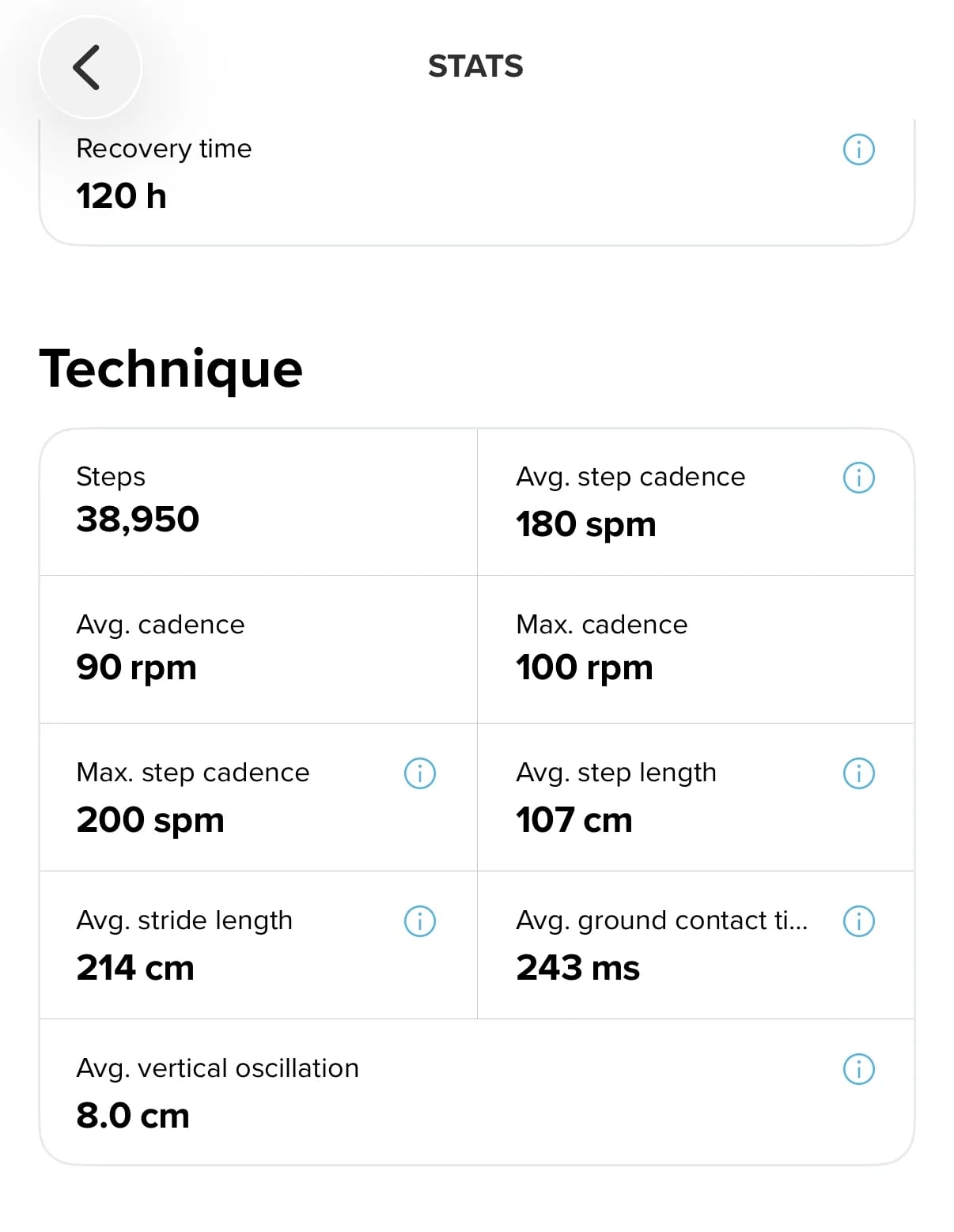
SPM (steps per minute) typically counts steps taken by both feet. Some devices or platforms may instead use RPM to count complete step cycles based on one foot. With that counting method, 90 RPM equals 180 SPM. Always check which units your device or platform uses.
Calculation methods and accuracy can vary between devices, so try to use the same device when comparing cadence data across runs.
For a more detailed look at your runs, the Suunto app lets you review recorded cadence alongside other workout metrics.
How to Measure Cadence Without a Watch
Without a running watch, you can estimate cadence using a timer and a simple step count:
- Count both feet: Count the total number of times either foot hits the ground in 30 seconds, then multiply by 2.
- Count one foot: Count the number of times just one foot hits the ground in 30 seconds, then multiply by 4.
For example, 85 total steps in 30 seconds equals approximately 170 SPM. If you count only one foot and record 43 steps in 30 seconds, that equals approximately 172 SPM.
This method estimates your cadence during the interval you counted—not your average cadence for the entire run.
How Do You Interpret Your Running Cadence Data?
To interpret your running cadence data, first identify the time period each number represents, then consider your pace and training conditions. Current cadence, average cadence, and long-term trends reflect different time scales, so each needs to be interpreted differently.
Current vs. Average Cadence
Current cadence is your step rate right now, or over a short, recent window, depending on your device. It moves as you speed up, slow down, hit hills, or shift between parts of a workout. It's useful for spotting clear changes in rhythm mid-run, not for summing up the whole session.
Average cadence summarizes your step rate across a full run or a specific segment. An average of 170 SPM doesn't mean you held 170 SPM the whole way. Your cadence will have risen and fallen at different points.
Before comparing averages, check whether each one covers a full run or a single segment. The average for a workout with a warm-up, fast intervals, and recoveries spans a different stretch of running than the average for one fast interval, so the two can't be compared directly.
Cadence Trends Over Time
Trends show recurring or sustained changes across runs in similar conditions, not a single figure from one workout. The most useful comparisons come from runs with a similar pace, route, elevation profile, and training goal.
Say your cadence usually sits between 168 and 172 SPM on easy runs over flat routes at a similar pace. One slightly higher or lower reading is nothing to read into. If you see a consistent shift across comparable runs, look at your pace, heart rate, and how you felt to understand what's behind it.
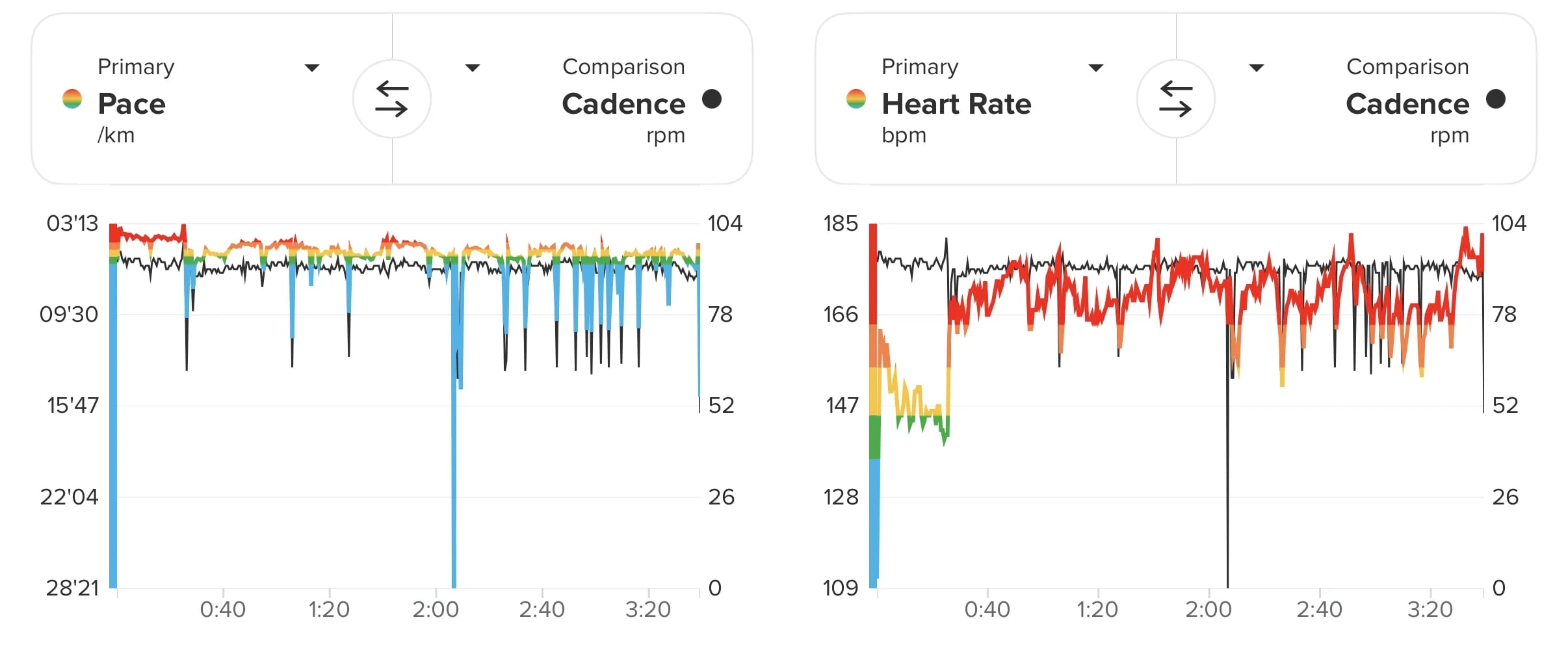
The value of long-term tracking is learning how your own rhythm evolves, not measuring yourself against someone else's cadence or a fixed standard.
Find the Rhythm That Works for You
Cadence is a tool for understanding your running rhythm, not a target to chase. It shifts with pace and conditions, so rather than chasing 180 SPM or someone else's numbers, focus on your own rhythm and how it changes over time in similar conditions.
If you have a clear reason to adjust your cadence, start with small changes in short practice intervals. Then judge whether the new rhythm feels natural and sustainable, supports your training goals, and suits your body. A higher number was never the point. The point is a rhythm that feels like yours and keeps you training consistently for the long term.
FAQ
What is a normal running cadence for beginners?
There's no single normal cadence for beginners. Cadence varies with pace, individual traits, and running conditions, so your own natural rhythm is a better starting point than anyone else's numbers.
Does increasing cadence make you run faster?
Not necessarily. Speed depends on both cadence and step length, so raising your cadence alone won't automatically make you faster.
Is a higher running cadence always better?
No. A higher cadence doesn't necessarily mean you're running faster, more efficiently, or more safely. Read it alongside your pace and how you feel on the run.
Does height affect running cadence?
Height may play a role, but it can't set a specific cadence target for you on its own.
Should you change your cadence during Zone 2 training?
Usually there's no need. In Zone 2, focus on staying within your target intensity and holding a natural, sustainable rhythm rather than chasing a cadence number. If you have a clear technique goal, try a small adjustment in short intervals, and return to your natural rhythm if running starts to feel noticeably harder.