Accelerating, climbing hills, kicking for the finish: each one asks your body to push hard against the ground in very little time.
Plyometric training gives runners a way to practice exactly that kind of rapid force production. This guide is for runners who already run regularly and want to add jumps to their routine. It covers how to choose exercises, how much to do and how long to rest, and how to fit plyometrics into your week alongside the miles you’re already running.
At a Glance
- Plyometric training develops explosive power through the stretch-shortening cycle. It may help runners improve jumping, acceleration, or running economy at specific speeds, although results vary between individuals.
- Beginners should first assess their physical readiness and ability to control their movements. Start with a small amount of basic, manageable jumps, focusing on stable takeoffs and landings before gradually increasing difficulty.
- Training volume, rest, and frequency should reflect exercise intensity and recovery. When combining plyometrics with running or strength training, prioritize the quality of the day's main workout.
- A decline in jumping performance, loss of control during landing, or joint or tendon pain are signs to reduce the workload or stop.
Table of Contents
- What Is Plyometric Training?
- Benefits of Plyometric Training for Runners
- Is Plyometric Training Right for You?
- Which Plyometric Exercises Should You Start With?
- How Much Plyometric Training Should You Do?
- When to Reduce or Stop Plyometric Training
- How to Fit Plyometric Training Into Your Running Routine
- How to Monitor Your Plyometric Training with Suunto
- Takeaways
- FAQ
What Is Plyometric Training?
Plyometric training is a form of training aimed at developing explosive power and includes both lower-body and upper-body exercises. Given the demands of running on lower-body force production and movement transitions, this article focuses on lower-body plyometric exercises commonly used by runners.
The core principle is known as the stretch-shortening cycle (SSC). During a jump, for example, the body quickly lowers before takeoff, stretching the muscles and tendons of the legs. It then rapidly transitions into the takeoff phase, helping the body move upward with greater speed and force. This process uses some of the elastic energy stored during the stretch, along with active muscle contraction and coordinated movement across the body.
Plyometric Training vs. Strength Training vs. HIIT
Plyometric training, strength training, and high-intensity interval training (HIIT) can all be included in a running or general fitness plan, but they differ in their training goals and programming. The table below can help you understand the role of each method in your plan and choose or adjust your workouts based on your needs.
| Training Type | Primary Goal | Common Exercises or Formats | Key Characteristics |
|---|---|---|---|
| Plyometrics | Develop explosive power | Lower-body explosive exercises such as bounding and repeated small jumps, as well as upper-body explosive exercises such as medicine ball throws | Emphasizes takeoff and landing quality. Rest periods should be sufficient for the exercise intensity to maintain performance. |
| Strength Training | Improve maximal strength, muscular endurance, or muscle hypertrophy | Strength exercises such as squats, deadlifts, and calf raises | Progressively adjusts load, sets, and repetitions. Rest periods depend on the training goal and load. |
| HIIT | Improve cardiorespiratory fitness and the ability to sustain high-intensity exercise | Alternating high-intensity efforts with low-intensity recovery intervals in activities such as running and cycling | Adjusts the training stimulus through work intensity, duration, and the ratio of work to recovery. |
The three overlap, but sharing an exercise doesn’t make them the same kind of training. A jump can be a plyometric drill or one of the work intervals in a HIIT session. Plyometric training is about rapid force production and movement quality, while HIIT shapes the training stimulus by alternating hard efforts with recovery.
Benefits of Plyometric Training for Runners
Plyometric training has shown to help develop explosive power and improve certain running-related measures. The specific effects depend on training background, exercise selection, and how your training is structured.
- Develop explosive power and improve jumping and acceleration: Through exercises involving takeoffs, landings, and rapid rebounds, plyometric training develops the ability to produce force in a short amount of time while improving movement transitions and control. This can support jumping and running acceleration during the initial phase of a sprint.

- Help improve running economy: Research has found that plyometric training may improve running economy at specific speeds in middle- and long-distance runners by developing rapid force production and improving the use of elastic energy stored in the muscles and tendons.
However, plyometric training is a supplement to your training plan, not a guarantee of improved running economy or race performance. Consistent running, event-specific speed training, strength training, and recovery remain important.
Is Plyometric Training Right for You?
Plyometrics can complement your running, but whether they belong in your plan depends on your current condition, your movement control, and your overall training load. You’re likely ready if you can tick these three boxes:
- Lower-body condition: You have no significant pain, swelling, or instability in the lower-body joints or tendons.
- Movement control: You can perform basic squats, single-leg stance exercises, and simple landing movements with reasonable control.
- Training and recovery: You can tolerate your current running or strength training workload and are recovering well.
Readiness looks different depending on age and training experience. If you’re an older adult or haven’t jumped in a long time, pay close attention to movement control and to whether your body handles the demands of jumping and landing. If you have a lower-body injury, have recently had surgery, have osteoporosis, or have any condition that affects how well you tolerate impact, get professional guidance first on which exercises and how much volume suit you.
Which Plyometric Exercises Should You Start With?
The following exercises offer options for runners with different training backgrounds and goals. They are not a fixed progression that you need to follow in order. Choose exercises based on the skills you want to develop, whether that means landing control and takeoff preparation, basic jumps and repeated bounds, or movements that demand greater jumping distance and single-leg control. You don’t need to complete them all in one session.
Before starting, choose a flat, stable, nonslip training surface with moderate cushioning, and warm up thoroughly with dynamic movements. Your warm-up can include easy jogging or brisk walking, dynamic mobility exercises, and low-amplitude basic jumps, gradually increasing the range of motion and force required.
Landing Control and Jump Preparation
If you’re unfamiliar with landing from jumps or tend to lose your balance after landing, start with the following exercises to build body control and prepare for takeoff.
- Snap-downs: Start standing with your feet hip-width apart. Rise onto your toes and raise your arms overhead, then quickly lower your heels and swing your arms down while bending your hips and knees. Stabilize your body in the lowered position. Keep your knees roughly aligned with your toes and maintain your balance. Beginners can start with the two-leg version and consider the single-leg version as their control improves.
- Squat jumps (SJ): Pause in a half-squat position, then push off the ground quickly to jump upward. Land, regain a stable standing position, and repeat. This exercise focuses on takeoff force and differs from a countermovement jump, which involves immediately jumping after a rapid downward movement.
Basic Plyometric Jumps
Once you can control your takeoffs and landings consistently, choose suitable exercises from the following options to practice the transition between lowering, extending, and taking off again.
- Countermovement jumps (CMJ): Start standing, quickly bend your hips and knees to lower your body, then immediately jump upward. Avoid pausing too long at the bottom, and regain a stable position after each landing.
- Pogo hops: Perform small, continuous two-leg jumps, emphasizing quick rebounds through the ankles to practice the transition from landing to the next takeoff. Keep your body stable and your rhythm consistent. Control the jump height first, then gradually increase the demands of repeated rebounds.

Exercises for Different Jumping Goals
If you can already perform basic jumps with consistent control, you can try the following exercises, which focus on vertical jumping, horizontal jumping, and single-leg force production and landing control, respectively.
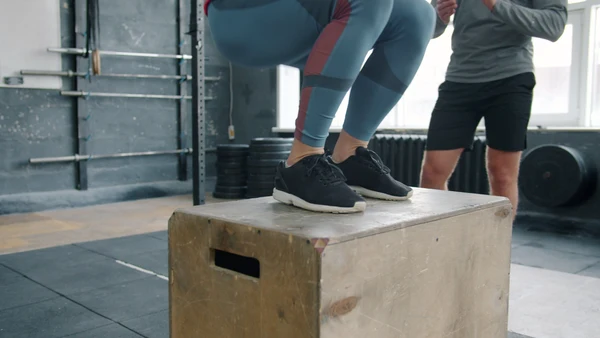
- Box jumps: Jump from the ground and land on a stable platform, practicing upward force production and landing control. Choose a box height that matches your ability and make sure you can land steadily. A higher box doesn’t necessarily indicate greater jumping ability, as how much you tuck your legs also affects whether you can reach the platform.
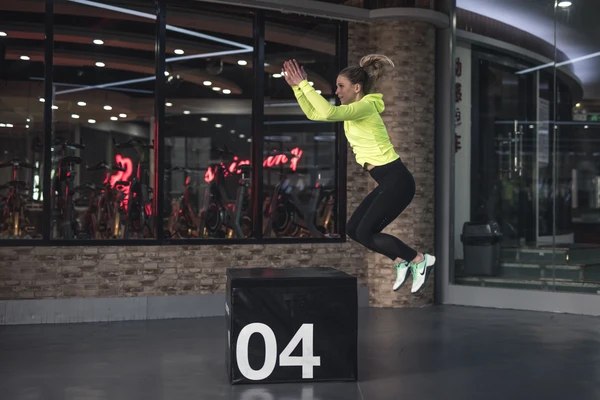
- Broad jumps: Push off with both feet and jump forward, practicing horizontal force production and landing control. Make sure you can maintain your balance after landing before gradually increasing the jump distance.
- Single-leg hops: Take off and land on the same leg, practicing single-leg force production, balance, and landing control. Start with small, individual hops, regaining a stable position after each landing before continuing.
How Much Plyometric Training Should You Do?
Start with a few exercises you can manage, see how your body responds, and build up gradually. When you progress, change one main variable at a time: a few more reps, an extra set, or a slightly harder exercise once your movement is stable.
A Simple Beginner Session
Here’s a beginner example showing the basic structure of a plyometric session. Use it as a starting template and adapt it to you. Before you begin, make sure you feel well and can control basic landings.
| Training Stage | Instructions |
|---|---|
| Dynamic warm-up | Combine easy jogging or brisk walking with dynamic mobility exercises and low-amplitude practice jumps to gradually prepare for training. |
| Landing preparation | Perform 1–2 sets of snap-downs, with 3–5 repetitions per set. Stabilize your body after each downward movement before resetting. |
| Basic jumps | Perform 1–2 sets of countermovement jumps, with 3–5 repetitions per set. Regain a stable position after each landing and rest sufficiently between sets to maintain consistent movement quality. |
| Finish and assess | There’s no need to add more jumping exercises. Pay attention to leg fatigue, soreness, and localized discomfort during and after the session. |
These sets and repetitions provide a low-volume starting point for beginners. You can gradually adjust the workload based on movement control, training experience, and recovery.
Sets, Reps, and Training Volume
Sets and repetitions are the most straightforward way to plan training volume. For example, performing 3 sets of 5 repetitions of an exercise gives you 15 total repetitions, but different exercises may require different sets and reps.
Foot contacts are another way to track plyometric training volume, referring to the total number of times one or both feet contact the ground during a session. Related research identifies foot contacts as one method of measuring plyometric training volume. However, impact intensity and mechanical loading vary between exercises, so foot contacts are more useful for tracking volume than for judging training intensity on their own.
Rest Between Sets and Sessions
Rest between sets should reflect exercise intensity and your ability to maintain movement quality. For jumps that require high-quality, rapid force production, you can use approximately 2–3 minutes as a starting point for rest between sets. For low-amplitude, lower-intensity repeated jumps, start with around 1–2 minutes. Adjust the actual rest period to your needs rather than following a fixed duration mechanically.
Allow enough time between sessions for your muscles, tendons, and joints to adapt to the previous workload. High-intensity jumps or higher-volume sessions generally require more recovery. If your legs are still noticeably fatigued or your movement control hasn’t returned to normal, postpone the next session. During recovery, you can also choose activities such as walking, recovery runs, or low-intensity cycling as forms of active recovery, depending on how you feel. There’s no need to force yourself to exercise more when fatigue is still significant.
Weekly Plyometric Training Frequency
For many beginners, one low-volume, manageable plyometric session per week is a reasonable starting point. Once you’re familiar with the exercises and can complete sessions consistently, you can gradually increase to two sessions per week based on your training goals, exercise intensity, and recovery. More experienced athletes can adjust frequency flexibly according to their overall training load and recovery status.
When to Reduce or Stop Plyometric Training
Plyometric training requires ongoing attention to movement quality and how your body responds. During each session, monitor whether your landings are stable, you can maintain your balance, and the height and rhythm of repeated jumps remain relatively consistent. These signs can help you decide when to adjust your training.
You can also use your phone to record your movements from the front or side. Video can help you assess landing stability, body sway, and jumping rhythm, making changes that are difficult to notice in real time easier to identify.
- Declining takeoff performance: If you’re doing repeated jumps and the later repetitions are noticeably lower or shorter, or your rhythm gradually slows, end the current set and rest sufficiently. If your performance doesn’t return to its previous level after resting, reduce the remaining workload or end the session.
- Breakdown in movement quality: If your knees visibly cave inward, your landings become unstable, your body sways excessively, or you need extra steps to regain your balance, reduce the difficulty. For example, lower the jump height, shorten the jump distance, or reset your stance after each landing. If you still can’t maintain stable control after making adjustments, stop the exercise.
- Pain or other unusual symptoms: Stop the exercise if jumping causes joint or tendon pain. Seek professional assessment if the pain persists or worsens, is accompanied by swelling, or affects your ability to walk normally.

How to Fit Plyometric Training Into Your Running Routine
When adding plyometric training to your running plan, consider the combined workload from running mileage, running intensity, and other lower-body exercises. Avoid simply stacking plyometric sessions on top of your existing schedule. The following are common ways to combine training, offering options for adjusting workout order and volume rather than fixed schedules you must follow.
- On the same day as an easy run: After a thorough warm-up, you can complete a small amount of plyometric training before your easy run. This helps you maintain jump quality before significant fatigue sets in.
- On the same day as a key running workout: Prioritize the quality of your key running session and avoid letting plyometric exercises interfere with the planned workout. If you can’t accommodate both without compromising performance, move the plyometric exercises to another training day rather than forcing yourself to jump when noticeably fatigued.
- On the same day as strength training: If you combine both in one session, perform plyometric exercises after a thorough warm-up and before strength training, while you’re less fatigued and better able to practice explosive movements. Adjust the overall lower-body workload as needed by reducing other strength exercises or sets.
How to Monitor Your Plyometric Training with Suunto
Once you incorporate plyometric training into your running plan, you can use real-time feedback during exercise and longer-term trends afterward to assess whether your current approach is appropriate.
If a session includes different activities, such as running, strength training, and plyometric exercises, you can select Cross Training mode on a Suunto sports watch to record the entire session.
During the workout, use perceived effort, real-time heart rate, and heart rate data for each lap to observe how your body responds at different stages and adjust the intensity or rest periods of subsequent activities accordingly. Keep in mind that heart rate reflects your cardiovascular response and cannot independently determine the quality of your jumps. For plyometric training, prioritize takeoff performance, landing control, and movement rhythm.
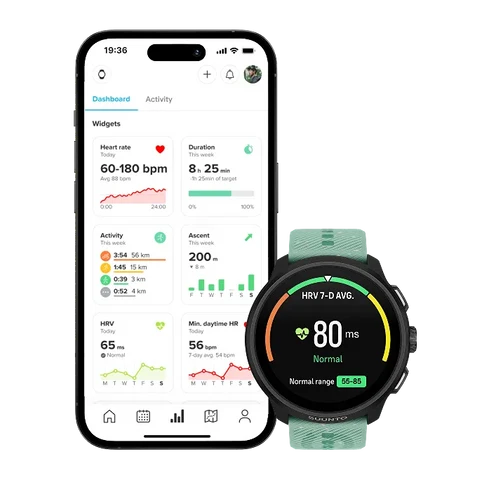
After the session, review trends in training load, sleep, and heart rate variability (HRV) in Suunto app to help guide subsequent training and recovery.
If you use a Suunto Race 3S, you can also try asking the Suunto AI Coach for personalized suggestions based on your training history, recovery, and goals. The number of jumps, exercise difficulty, and training frequency should still be adjusted according to your actual movement performance and how your body responds.
Takeaways
Plyometrics fit into your plan best when you start small: a short session of basic exercises, then a rhythm that works for you. Look beyond jump height and distance. Notice whether your movements feel more stable, your force production feels smoother, and the sessions support your main workouts. Build through consistent practice, raise the difficulty as your ability grows, and let this extra training feed your long-term goals.
FAQ
How Long Should a Plyometric Workout Last?
As a general guide, plan for 15 to 30 minutes, including your warm-up and rest between sets. The exact length depends on how many exercises, sets, and rest periods you include.
Are Jump Rope and Sprinting Forms of Plyometric Training?
Jump rope can be a form of plyometric training. Sprinting is generally classed as running-specific training rather than dedicated plyometric work.
Both use the stretch-shortening cycle (SSC), but that alone doesn’t make something plyometric. Jump rope behaves most like plyometrics when it emphasizes quick ground contacts and continuous rebounds. When the focus shifts to long, sustained skipping, it becomes more about endurance and coordination. Sprinting also relies on the SSC, but its main goal is running speed, which makes it a good complement to dedicated plyometric exercises.
What Is a Plyometric Push-Up?
A plyometric push-up is a push-up where you drive up quickly and forcefully enough for your hands to leave the ground briefly. As your hands land, bend your elbows to absorb the impact and keep your torso stable. It builds upper-body explosive power, a reminder that plyometric training extends beyond lower-body jumps.
Do Plyometrics Build Muscle?
They can. Plyometric training can promote some muscle growth, but its main purpose is developing explosive power. Treat any muscle gain as a bonus rather than the goal.