Suunto Nautic User Guide
Deco profile
Deco profile can be selected in Dive options > Algorithm > Deco profile.
Continuous decompression profile
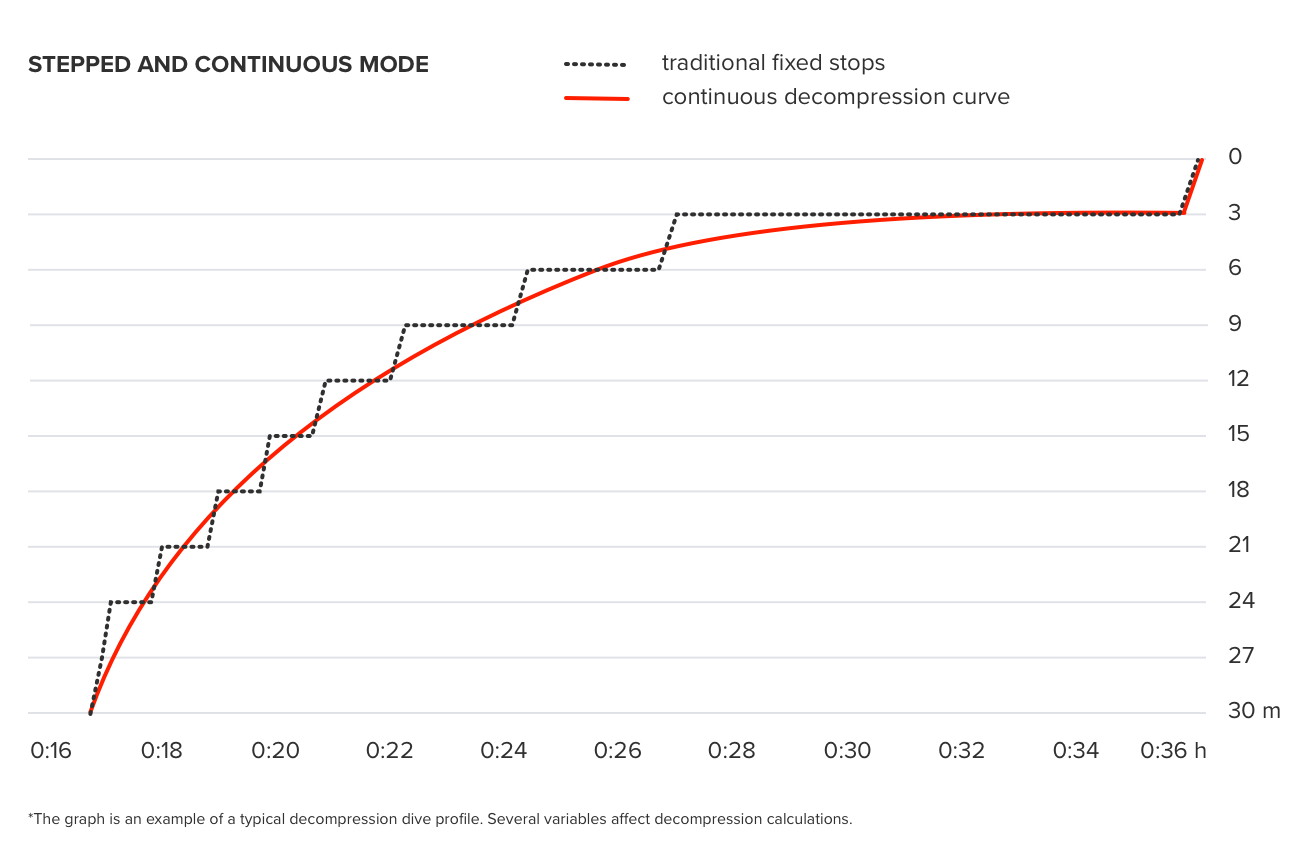
Traditionally, since Haldane’s 1908 tables, decompression stops have always been deployed in fixed steps such as 15 m, 12 m, 9 m, 6 m and 3 m. This practical method was introduced before the advent of dive computers. However, when ascending, a diver actually decompresses in a series of more gradual ministeps, effectively creating a smooth decompression curve. The advent of microprocessors has allowed Suunto to more accurately model the actual decompression behavior. During any ascent involving decompression stops, Suunto dive computers calculate the point at which the control compartment crosses the ambient pressure line (that is the point at which the tissue’s pressure is greater than the ambient pressure), and off-gassing starts. This is referred to as the decompression floor. Above this floor depth and below the ceiling depth is the decompression window. The range of the decompression window is dependent on the dive profile.
The optimal decompression occurs in the decompression window, which is displayed by both upward and downward arrows next to the depth value. If the ceiling depth is violated, a downward pointing arrow and an audible alarm will prompt the diver to descend back to the decompression window.
Off-gassing in the leading fast tissues will be slow at or near the floor because the outward gradient is small. Slower tissues may be still on-gassing and given enough time, the decompression obligation may increase, in which case the ceiling may move down and the floor may move up. The decompression floor represents the point at which the algorithm is seeking to maximize bubble compression, while the decompression ceiling is maximizing off-gassing.
The added advantage of having a decompression ceiling and floor is that it recognizes that in rough water, it might be difficult to maintain the exact depth to optimize decompression. By maintaining a depth below the ceiling but above the floor, the diver is still decompressing, although slower than optimal, and provides an additional buffer to minimize the risk that waves will lift the diver above the ceiling. Also, the continuous decompression curve used by Suunto provides a much smoother and a more natural decompression profile than the traditional “step” decompression.
Stepped decompression profile
In this decompression profile, the ascent has been divided into traditional 3 m (10 ft) steps or stages.
In this model the diver decompresses at traditional fixed depths. The ceiling value in the switch window will show the depth of the next step and once the diver reaches the decompression window, a timer starts showing the needed length of the decompression stop.
See Example - Multigas mode for an example decompression dive.