Plenty of runners have thought about lifting. Fewer actually start, usually because of three worries: not knowing where to begin, fearing that heavy legs will wreck tomorrow's run, or picking up an injury from poor technique.
This guide to strength training for runners answers those questions one at a time: what lifting does for your running, how to start, where it fits in your week, and how to log it so you can tell whether it's working.
Table of Contents
What Is Strength Training?
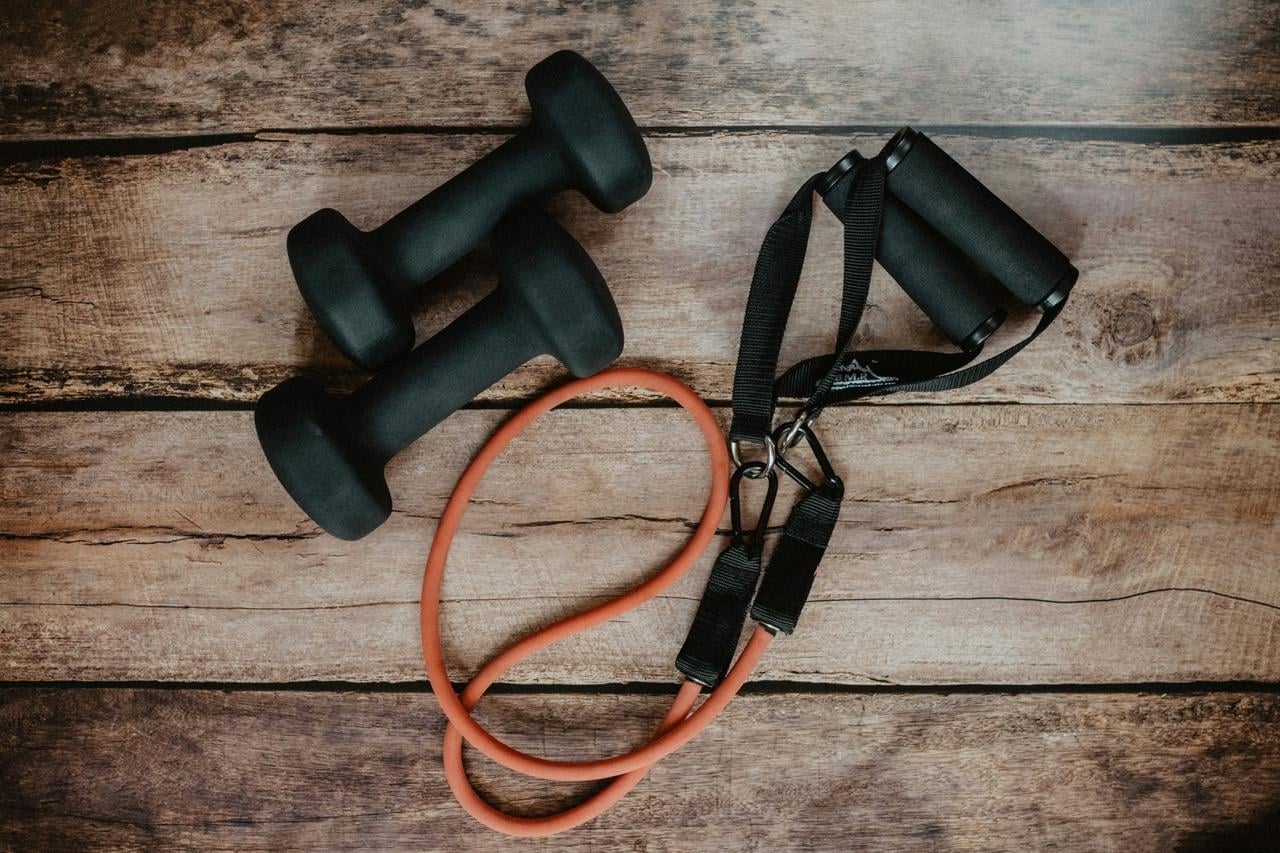
Strength training means making your muscles work against resistance. The resistance can come from your body weight, a band, dumbbells, a barbell or a gym machine, which is why it's also called resistance training.
For runners, the goal is landing and pushing off with more stability and less energy cost, so your body can handle the miles you stack up every week.
Why Runners Need Strength Training?
Strength training pays off for runners in three ways: you run with less effort, lower your injury risk, and protect muscle and bone for the long haul.
Run More Economically
Strength training has been proved to be one of the most effective ways to improve running economy. Running economy is the energy cost of holding a given submaximal pace. The less oxygen you use at that speed, the more economical you are, and economy is one of the best predictors of distance running performance.
The improvement most likely comes from the neuromuscular system: better muscle recruitment, faster force development, and stiffer muscle-tendon units. Stiffer tendons store elastic energy when you land and return it as you push off, which lowers the energy cost of running. In a 2008 study, Norwegian researchers had well-trained distance runners keep their normal running and add three heavy half-squat sessions a week. After eight weeks, running economy improved by around 5%.
One caveat: improved economy does not guarantee faster racing. Your aerobic engine and VO2max still get built by running itself, so strength work belongs alongside your running.
Become a More Resilient Runner
The other well-supported benefit of strength training is a lower injury risk. Consistent training depends on staying healthy. Tendons, ligaments and bone all adapt to progressive load, and stronger muscle absorbs more of the impact from every landing, taking strain off the places runners break down most: knees, Achilles tendons and shins. When you repeat the same motion thousands of times a week, that protection adds up.
Protect Muscle and Bone for the Long Run
Strength training also pays a long-term dividend: it helps you hold on to muscle and bone. Muscle mass declines with age unless you load it regularly. A commonly cited estimate puts the loss at roughly 3% to 8% per decade after middle age (the rate varies with training history, sex and how it's measured, and tends to be steeper in people who sit most of the day). Bone density falls too, and faster in women after menopause. Running trains your heart and legs but does little for your upper body and trunk. Resistance training fills that gap and is one of the most reliable ways to keep muscle and slow bone loss. The payoff arrives in a decade, when you still want to be running.

Strength Training and Cardio: Which First?
Run first, or lift first? Runners ask this all the time. Both fit in the same week, even the same day. Two things matter most: which session is the priority that day, and whether fatigue from the first will cost you quality in the second.
The overall rule: separate hard sessions so each key session gets the quality it needs.
In practice, that comes down to three things:
- One priority per day. If the day's main session is a hard run, the run is the priority and any strength work stays light. If strength is the priority, skip the hard run that day.
- Strength first, easy run after, when both land on the same day. A meta-analysis found that placing strength before endurance in the same session gives better lower-body strength adaptation with no cost to aerobic gains. When the run is easy, this is the better order.
- Leave at least six hours between strength work and running. Sessions that compete for the same adaptations need that gap.
Put those three rules into a normal week and you get something like this:
| Common scenario | Suggested order and spacing |
|---|---|
| Interval, tempo or long-run day (running is the priority) | Run only, or run first and do light strength work at least 6 hours later |
| Easy run plus strength on the same day | Strength first, easy run after |
| Lower-body strength day (strength is the priority) | No hard running that day. Run the next day, or at least 6 hours later |

How to Start Strength Training as a Runner
Master the Fundamental Movement Patterns
You don't need complicated equipment or a long list of exercises to start. A handful of basic patterns covers what runners actually need:
- Squat patterns (back squat, goblet squat): builds the whole glute-and-leg chain;
- Hip drive (deadlift, hip thrust): the push you feel when you drive off the ground;
- Upper-body push and pull (push-up, row): holds your posture together in the final miles;
- Core stability (plank, side plank): the base your running posture sits on.
Learn the movement with no weight before you add any, then build resistance slowly. That's the most important rule at this stage. When you're ready for more, work through 12 High-Intensity Strength Training Exercises for Endurance Athletes to widen your library.
Choose the Right Load and Reps
The general rule with load and reps: heavy weight and low reps build maximal strength, while moderate weight and higher reps build muscular endurance. If you're new to lifting, start with a weight you can move for 8 to 12 clean reps, do 2 to 3 sets, and put form first. Once the movement is stable, work toward heavier ranges.
What you start with matters less than progressive overload: your body adapts to a fixed load within a few weeks, then progress flattens out. So add weight, reps or sets on a schedule. Without that, training quietly turns into maintenance and the gains stop.
Avoid Common Beginner Mistakes
Four mistakes account for most beginner problems:
- Loading up too fast. Tendons adapt more slowly than muscle, so when you jump the weight, the tendon complains first.
- Skipping the warm-up. Five to ten minutes of dynamic work plus a few light sets cuts down on sloppy form once the real sets start.
- Running the same program for months. Once you've adapted, a fixed load stops providing a stimulus, so keep moving it forward.
- Training through pain. Muscle soreness after a session is normal. Sharp pain, pain at a joint, or pain on one side only is a stop signal. End the session and get it looked at if it keeps showing up.
How to Fit Strength Training Into a Runner's Week
How Often Runners Should Strength Train
For most runners, twice a week, with about 48 hours between sessions for the same muscle group, is the baseline that balances results and recovery. It also lines up with the WHO guidelines and the ACSM position stand. When mileage is high you can drop to once a week to maintain, then go back to two or three sessions in the off-season. Frequency and per-session volume belong together: two sessions you actually finish beat four you barely survive.
A Sample Week: Three Runs and Two Strength Sessions
Here's one arrangement that's easy to follow:
| Mon | Tue | Wed | Thu | Fri | Sat | Sun |
|---|---|---|---|---|---|---|
| Rest or easy activity | Strength | Easy run | Strength | Rest or easy activity | Intervals or tempo | Long run |
Treat this as a starting point, not a fixed plan. If the week holds a key speed session or a long run, protect their quality, and when something has to move, move the strength session. If strength and running land on the same day, do the one that matters more first.
When Results Typically Appear
The first changes are ones you can't see. In the opening weeks your nervous system gets better at recruiting muscle, and weights that felt heavy start to move under control. That's classic neural adaptation. Around four to six weeks, movement patterns and basic strength take shape. The injury-protection side, things like tendon stiffness and bone density, takes longer, and tendons usually need at least eight to twelve weeks of consistent loading. Running economy moves on a months-long timeline too, and the controlled trials in a meta-analysis of highly trained middle- and long-distance runners (Balsalobre-Fernández et al., 2016) ran for 8 to 12 weeks. In other words, almost none of the benefits of strength training arrive quickly, which is why the next section is about consistency and tracking.
Staying Consistent and Tracking Progress
Honestly, plenty of runners will never love the gym the way they love running, and that's fine. Motivation matters less than making it easy to do: same days, same time slot, no weekly re-planning. Pick a format you'll actually repeat, whether that's a pair of dumbbells at home, a bodyweight routine, or the machine area at the gym.
Consistency also needs feedback you can see. Log every strength session in Suunto and progress stops being a feeling:
- Gear: pick a Suunto watch with a strength training mode. The current Race, Vertical, Run and Ocean lines all include it.
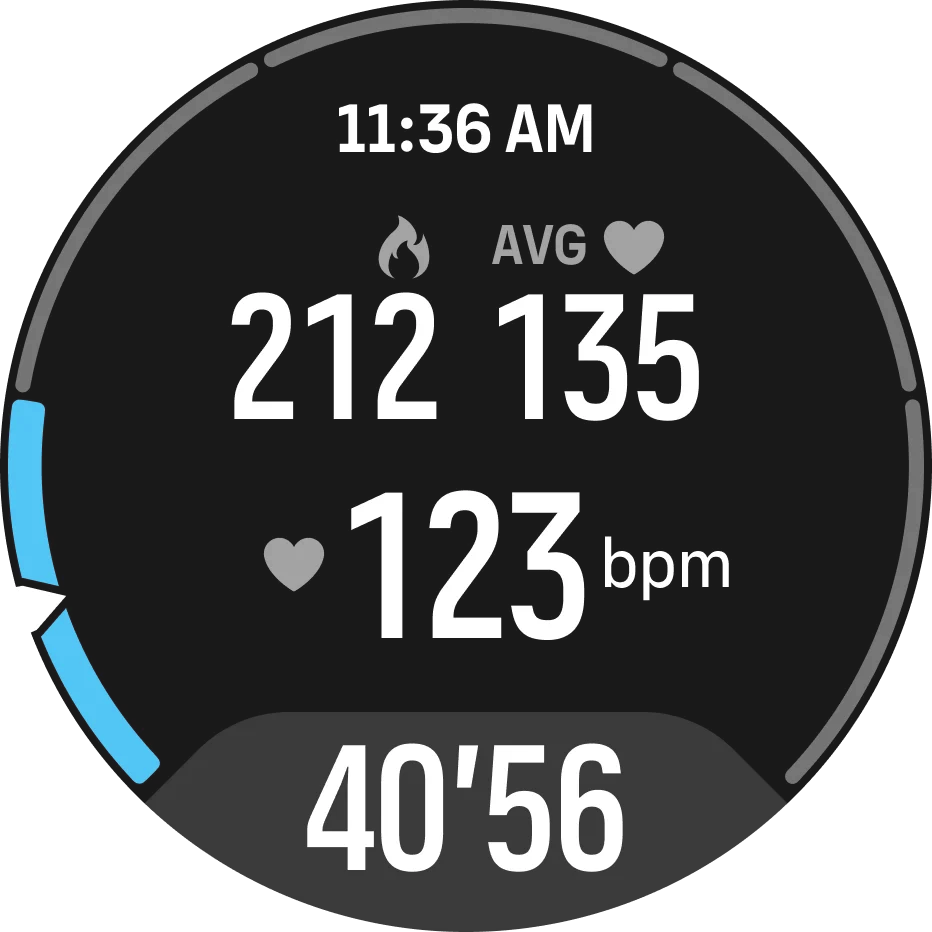
- How to log it: pick the Weight Training sport mode on your watch before you start. You can set a target duration first if you like. Once you're recording, duration, heart rate, heart rate zones and estimated calories show on the display and save in the background. After each set, press Lap to see the average and max heart rate for that set.
- For more detail: search SuuntoPlus Store and install the sport app Strength Tracker.
- Turn it on: before you start a Weight Training session, or while one is running, enable Strength Tracker in SuuntoPlus. Once the workout is going, press the middle button or crown to switch to its screen.
- Record: pick the muscle group you're training. The watch shows your rep count, heart rate and selected muscle group at the same time. After each set, press the upper button to save it, then look back at rest time and how the previous set went.
- Read the Load Score: the app scores each set as training volume builds, so you can judge the relative load of one set and the overall intensity of the session. That tells you more about the work you actually did than heart rate does, and it beats trying to remember how many sets you got through.
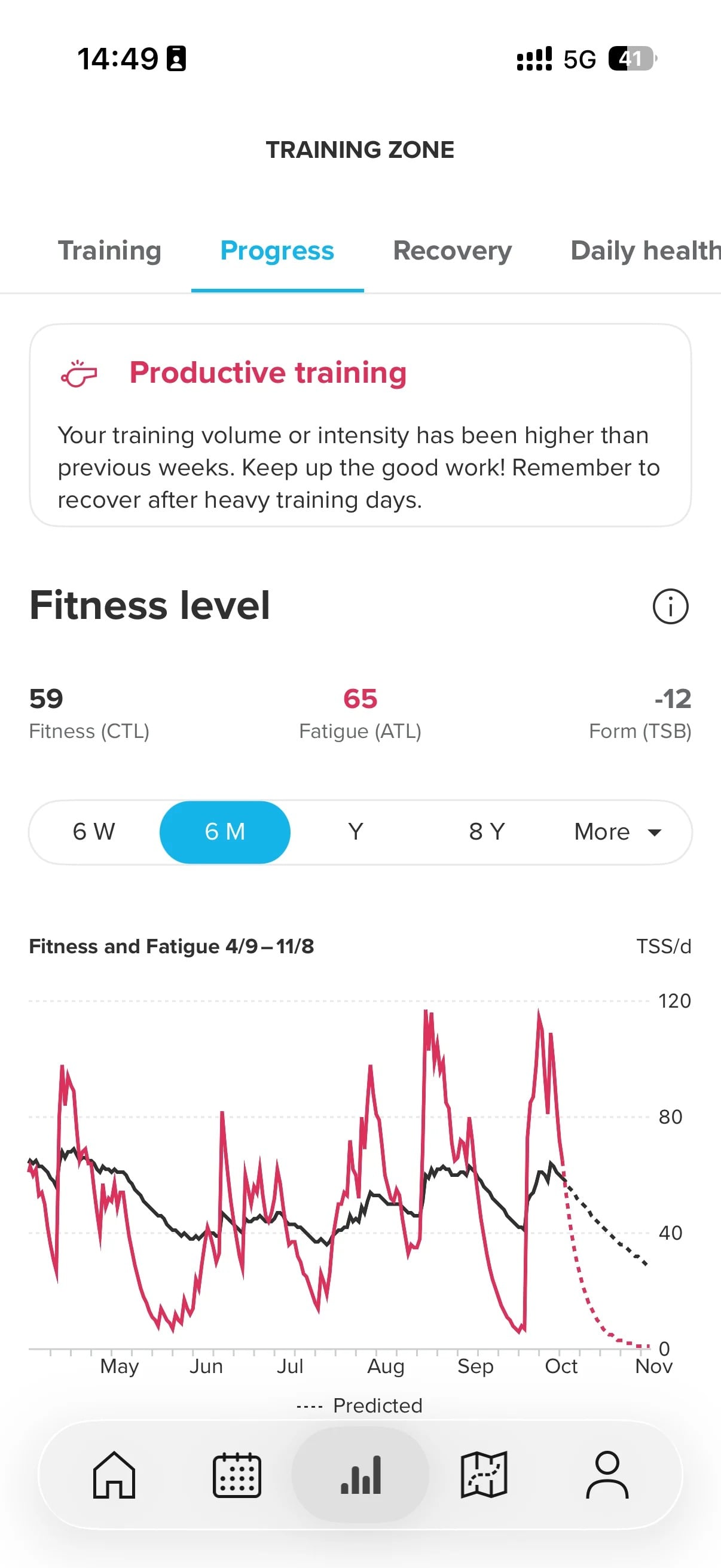
- Where to check: after a session, open Activities in the Suunto app for duration, average and max heart rate, training stress score (TSS) and excess post-exercise oxygen consumption (EPOC). For the long view, open Progress under Training Zone and check your fitness (CTL) curve.
How to Assess Your Progress
Your fitness curve only tracks accumulated training load, so it can't tell you how much stronger you've got. Assess progress from data plus how you feel. A few angles to use:
- Movement control and load progression: the same weight now moves for more clean reps, or the same sets feel easier.
- Running economy and performance when you're tired: in the second half of a long run or a hard block, pace holds more easily and perceived effort climbs more slowly, and your form stays efficient under fatigue.
- Long-term load and recovery balance: in Progress, the CTL curve trends flat or gently upward while you still wake up feeling good and recover well between runs. That's your body absorbing the new strength work.
Conclusion
Go back to the worry at the top and the answer is simple: you don't need a perfect plan to start strength training. Begin with twice a week, a few basic movements and a load you can control, then adjust based on how you feel and what your watch records. Strength arrives in weeks and months, so showing up consistently beats getting it perfect on day one.
FAQ
Will strength training slow down my running?
No, as long as you train like a runner. Your legs may feel heavy for the first two or three weeks, and that fades. Over time, better economy means the same pace costs you less. The slowdown worry comes from high-volume, bodybuilding-style lifting, which is very different from a runner's low-frequency sessions slotted between runs.
Will lifting make me bulky, and do men and women need to train differently?
With a runner's mileage and diet, visible size is hard to build. High-volume endurance work alongside strength training also tends to limit muscle growth.
The principles are the same for men and women: choose loads based on what you can do now. Training background matters far more than sex. For women, bone density and injury prevention deserve particular attention.
Should runners lift heavy or light?
The evidence on running economy leans toward heavier loads, but beginners should build a base with a controllable weight first, then add load over a month or two. Heavy is relative to you: a weight you can move for 4 to 8 clean reps with something left in the tank is heavy enough.
What if I have an old injury?
Start by finding out what the injury is and how well it has healed. Some conditions come with clear contraindications, so the safest move is an assessment from a doctor or physiotherapist. Once you're cleared, start with a light load, a small range of motion, and no pain, and stop if it hurts. Most old injuries need progressive loading to get strong again, as long as you begin carefully.